Cut Error 44.7%: Data First AI Demand Forecasting for Australia
9 min readOmniPulse

AI-driven demand forecasting combines historical sales data with signals like promotions, weather and inventory levels to predict future demand more accurately than traditional statistical methods alone. A collaborative forecasting study from QUT found that sharing downstream data cut forecast error by 44.7% against a manufacturer-only benchmark. Around 12% of Australian businesses already use AI in some part of their operations, though the uplift depends heavily on data quality and how well the signals are designed.
TL;DR:
- High accuracy gains depend heavily on data quality, structuring event calendars, and capturing promotion signals rather than solely on choosing sophisticated algorithms.
- For most businesses, gradient-boosted trees like XGBoost outperform deep learning models unless forecasting highly volatile or new-product categories.
- A thorough pilot involves defining KPIs, auditing data, benchmarking against existing forecasts, and running shadow tests for at least one seasonal cycle.
- Costs include data preparation, model experimentation, system integration, ongoing support, and change management, with benefits measured mainly by reduced stockouts and improved fill rates.
Table of Contents
- What AI demand forecasting solves and where it fits
- The data and models that actually move the needle
- What the evidence says about accuracy gains and their limits
- A practical roadmap from pilot to production
- Governance, explainability and managing vendor risk
- What AI demand forecasting actually costs to implement
- Data sharing and event modelling beat model complexity
- How OmniPulse turns forecasting gaps into a concrete roadmap
- Sources
- FAQ
What AI demand forecasting solves and where it fits
Demand forecasting isn’t one problem, it’s several, and each needs a different modelling approach. Short-term forecasts (days to weeks) drive replenishment and staffing decisions. Medium-term forecasts (weeks to months) support procurement and promotional planning. Long-term forecasts (quarters to years) feed capacity and capital investment decisions, where the cost of getting it wrong is measured in warehouse leases and supplier contracts rather than a few days of stockouts.
New products present a distinct challenge often called cold-start forecasting. There’s no sales history to learn from, so models rely on analogous products, category trends or transfer learning from similar launches. Established stock-keeping units, by contrast, have years of pattern data to draw on, which makes them far easier to forecast reliably.
The output of any of these forecasts only matters once it changes a decision. In practice, forecasts feed:
- Procurement and purchase order timing, so stock arrives before it’s needed rather than after demand spikes.
- Inventory allocation across warehouses or stores, reducing both overstock and shortages.
- Staffing and rostering decisions tied to expected volume.
- Promotion planning, where forecasts help estimate the incremental lift a campaign will generate.
Getting the typology right before choosing a model matters more than most businesses assume. A retailer trying to forecast a new product launch with the same model built for stable, high-volume staples will get poor results no matter how sophisticated the algorithm is.
The data and models that actually move the needle
Model choice matters less than most vendors suggest. What separates an accurate forecast from a mediocre one is usually the quality and breadth of the input signals.
The core inputs worth prioritising:
- Point-of-sale and shipment data, ideally at the finest granularity available.
- Inventory positions across the supply chain, not just at the point of sale.
- Promotion and pricing calendars, including planned discounts and bundle offers.
- Weather data, particularly for seasonal or weather-sensitive categories.
- Event calendars covering public holidays, sporting fixtures and other demand-shifting occasions.
On the modelling side, most production forecasting systems use a mix rather than a single technique:
- Statistical baselines (exponential smoothing, ARIMA) remain useful for stable, low-volume items where complexity adds cost without adding accuracy.
- Gradient-boosted trees, particularly XGBoost, handle mixed numerical and categorical signals well and are a common workhorse for retail and manufacturing forecasts.
- Ensemble methods that blend several model types tend to outperform any single model on complex, high-variability demand patterns.
- Long short-term memory (LSTM) networks capture sequential patterns well but need more data and tuning than most mid-sized businesses can justify for every product line.
- Hybrid or switching models apply different techniques to different product segments, using simpler methods for stable items and more complex ones where volatility justifies it.
The Parliamentary committee report on AI adoption frames demand forecasting as one of the more tangible AI applications in manufacturing and supply chain optimisation, precisely because it draws on data most businesses already collect. The harder work is joining that data up, not finding a cleverer algorithm.
A frequent mistake is chasing model complexity before signal quality. A well-built XGBoost model fed with a complete promotion calendar will usually beat a poorly-tuned LSTM working from sales history alone.
What the evidence says about accuracy gains and their limits
The most useful recent evidence on AI demand forecasting comes from two studies with very different scopes, and both come with caveats worth taking seriously before setting pilot expectations.
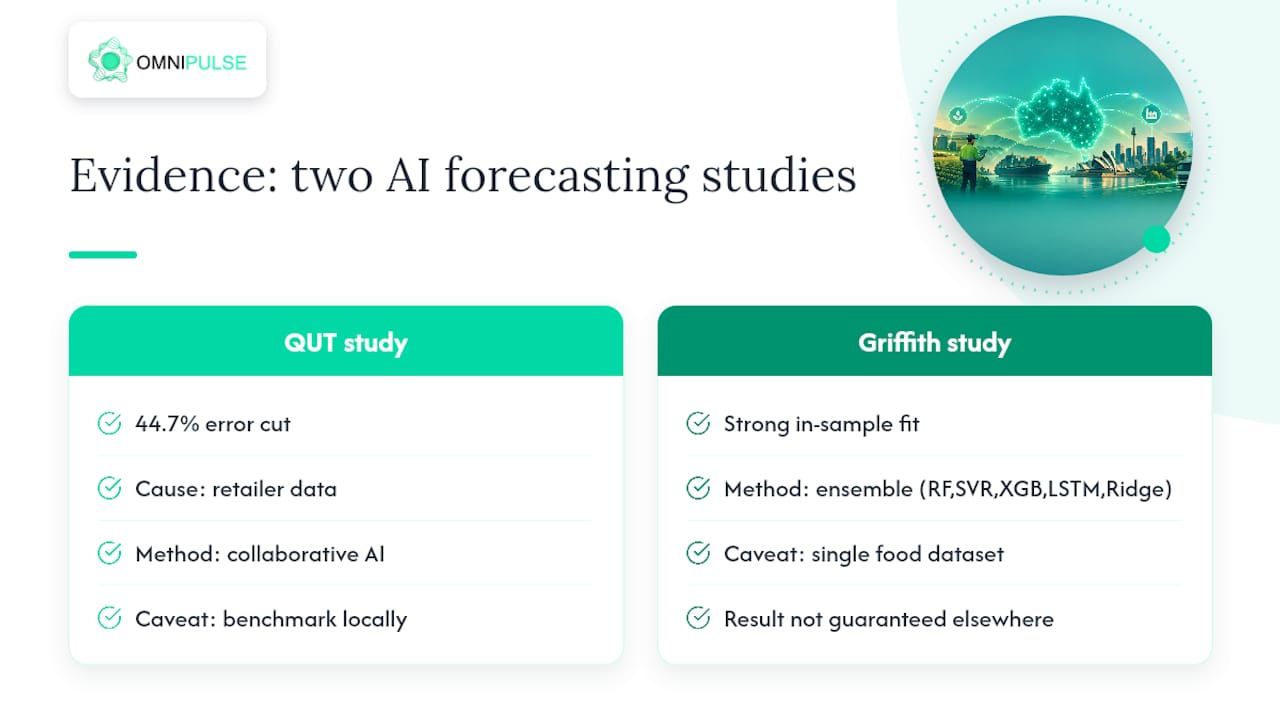
A collaborative AI forecast reduced total absolute error by 44.7% compared with a manufacturer-only XGBoost forecast, according to the QUT collaborative analytics study. The researchers’ key insight was that the gain came largely from sharing downstream retailer data, not from a more sophisticated algorithm.
The Griffith University food-demand study took a different approach, stacking random forest, SVR, XGBoost, LSTM and ridge regression into a single ensemble. On its dataset, the ensemble reported very strong in-sample results, including a high R² and low mean absolute error and MAPE. Those figures describe performance on one food-demand dataset under specific conditions, not a guarantee that any ensemble will perform the same way elsewhere.
Both studies point to the same practical lesson: published accuracy gains are context-specific. A pilot should be benchmarked against your own current forecast, not against a headline figure from someone else’s dataset, and results should be reported with a confidence range rather than a single number.
A practical roadmap from pilot to production
Moving from an idea to a working forecasting system is less about the algorithm and more about sequencing the decisions correctly.
- Define the use case and success metrics first. Tie the pilot to a specific business KPI, such as inventory days on hand, order fill rate or stockout frequency, rather than a vague accuracy target.
- Audit data readiness. Check that point-of-sale, inventory and promotion data are complete, consistently timestamped and accessible in a usable format before any modelling starts.
- Assemble the missing signals. If promotion flags or event calendars aren’t captured systematically, build that structure before adding model complexity.
- Design the pilot with a clear benchmark. Compare the new forecast against your current planner-adjusted forecast, not against an industry average.
- Run in shadow mode first. Let the model generate forecasts in parallel with existing processes for a defined evaluation window before it influences any live decision.
- Set automation boundaries. Decide which forecast ranges can trigger automatic replenishment and which require human review, particularly around promotions or new products.
- Monitor for drift. Track forecast error over time and set a retraining cadence, since demand patterns shift as markets, competitors and customer behaviour change.
- Plan for rollback. Keep the previous forecasting process available as a fallback if the new model underperforms after deployment.
Pro Tip: Run your shadow-mode evaluation across at least one full seasonal cycle before switching any decision over to the model, otherwise you’re judging performance on conditions that won’t repeat.
The businesses that get this right tend to spend more time on steps two and three than on model selection. A clean, well-structured promotion calendar often does more for accuracy than switching from one algorithm to another.
Governance, explainability and managing vendor risk
Deploying a forecasting model without governance is how a promising pilot turns into an operational risk. Australia’s Voluntary AI Safety Standard sets out guardrails around transparency, accountability and monitoring that map directly onto forecasting deployments: who can access the underlying data, how the model’s outputs are monitored, and when a human needs to review a decision before it executes.
Before signing with a forecasting vendor, work through:
- Data portability: can you export your historical data and model outputs if you switch providers.
- Service level agreements covering uptime, support response and forecast refresh frequency.
- Explainability features that let a planner see why a forecast moved, not just the number itself.
- Security practices around how your sales and customer data are stored and processed.
- A documented exit plan in case the vendor relationship ends.
The operational rule worth holding onto: verify every new forecast in shadow mode before it’s allowed to trigger automatic purchase orders or stock transfers. A model that looks accurate in testing can still produce one bad forecast that costs more than months of accumulated gains.
What AI demand forecasting actually costs to implement
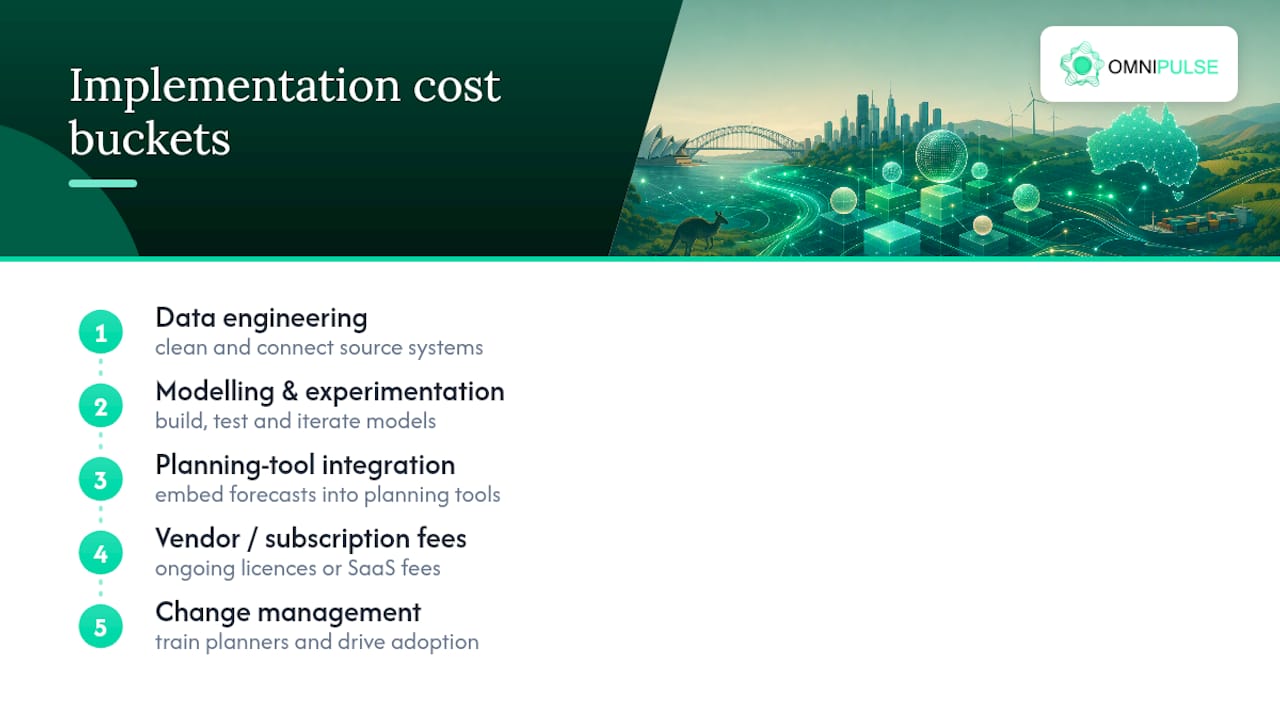
Costs typically fall into five buckets: data engineering to clean and connect source systems, modelling and experimentation time, integration with existing planning tools, ongoing vendor or subscription fees, and change management to get planners using the new outputs.
A conservative ROI case starts with the metrics already tracked: expected improvement in fill rate, reduction in stockout frequency, and working capital released from lower safety stock. Government-backed projects, such as a GrantConnect-funded ecommerce forecasting platform, show public funding pathways exist for AI commercialisation, but they’re evidence of policy support, not a benchmark for what your own project should cost.
Data sharing and event modelling beat model complexity
The evidence keeps pointing the same direction: businesses get more from sharing downstream data and structuring event calendars than from chasing a more advanced algorithm. Reserve deep learning and transfer learning for genuinely hard problems, new-product launches or highly volatile categories, and spend the early budget on signal quality instead. Most forecasting failures trace back to missing promotion flags, not an underpowered model.
— Brodie S
How OmniPulse turns forecasting gaps into a concrete roadmap
Better demand forecasts only pay off if the rest of the business is ready to act on them, and that’s usually where mid-sized companies get stuck. OmniPulse runs a Business Diagnostic Process built to find where AI, including forecasting, can unlock revenue that’s currently sitting in the gaps between systems and teams.

- The diagnostic identifies revenue opportunities and prioritises them by value and feasibility.
- If the process doesn’t uncover enough opportunity, the consulting firm continues working until it does, without charging extra.
- From there, the engagement produces a tailored roadmap covering pilot design, data readiness, and the path to production.
If forecasting accuracy or broader AI adoption is on your radar for 2026, book a 30-minute AI readiness session and find out what a proper diagnostic would surface for your business.
Sources
- A Collaborative Analytics Framework for Artificial Intelligence-Based Demand Forecasting in Supply Chains | QUT ePrints
- Griffith University food-demand study
- Business adoption of artificial intelligence accelerates 2024–25 (ABS media release)
- Voluntary AI Safety Standard — Safe and Responsible AI
FAQ
Will AI replace demand planners?
No, AI is more likely to change what planners spend their time on than replace them outright. The QUT collaborative study found the biggest accuracy gains came from better data sharing, which still requires people to design, negotiate and maintain those data flows. Planners increasingly focus on exceptions, promotions and judgement calls rather than routine forecast adjustments.
Which AI approach works best for forecasting?
There’s no single best approach, it depends on the demand pattern being forecast. Gradient-boosted trees like XGBoost are a common workhorse for mixed signals, while ensembles combining several model types have shown very strong results in specific contexts such as the Griffith food-demand study. Simpler statistical models often remain the better choice for stable, low-volume items.
What are the main types of demand forecasting?
Demand forecasting is generally split by time horizon: short-term for replenishment and staffing, medium-term for procurement and promotions, and long-term for capacity and capital planning. A separate distinction applies to new products, where cold-start forecasting relies on analogous items and transfer learning rather than direct sales history, as noted in UNSW research on demand prediction.
How much does AI demand forecasting cost to set up?
Costs vary by data readiness, integration complexity and whether you build or buy, and they aren’t published as a single industry figure. Typical spend covers data engineering, modelling, integration with existing planning systems and change management, alongside any vendor subscription fees. A realistic business case weighs these costs against expected gains in fill rate and reduced stockouts before committing budget.