Australia: 5 Layers That Lock In Enterprise AI and Contract Fixes
13 min readOmniPulse
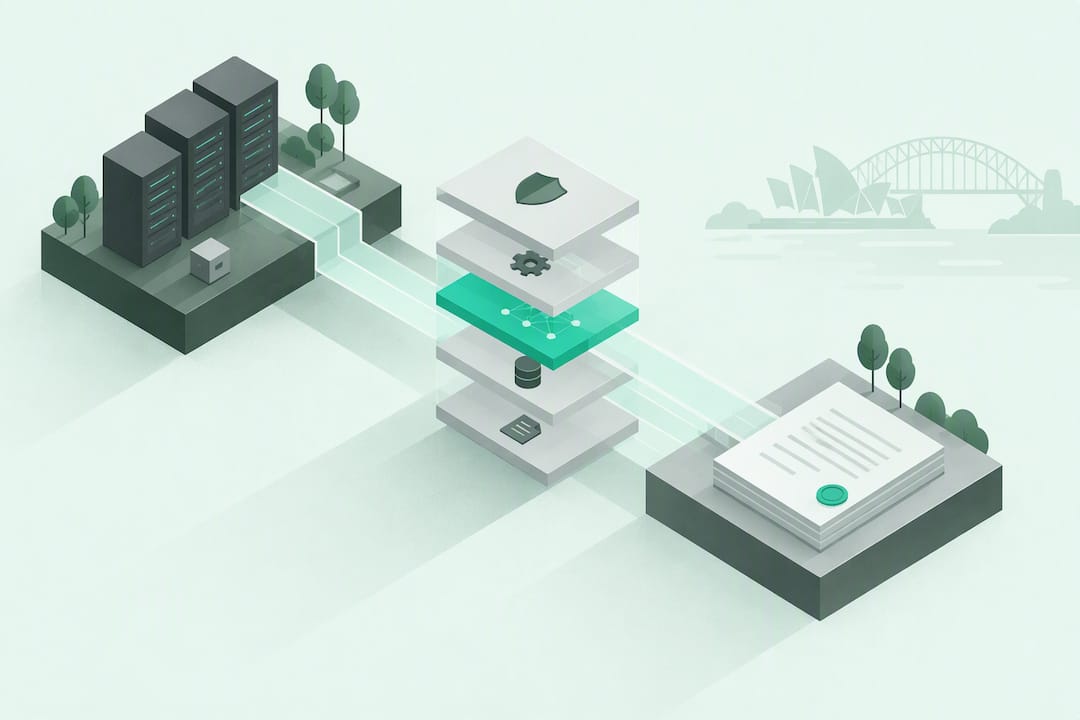
AI vendor lock in happens when the cost or complexity of switching AI providers becomes so high that an organisation stays put, even when a better option exists. It’s a sharper problem than traditional SaaS lock-in because the assets trapped inside an AI system, tuned prompts, embedded workflows, agent memory, aren’t just data. The primary defence is architectural: build a model-agnostic routing layer, insist on open standards, and back it with procurement clauses that force vendors to hand over your own artefacts on request.
TL;DR:
- Most AI lock-in occurs across multiple layers, including models, workflows, retrieval systems, integrations, and audit logs, each requiring specific mitigation strategies.
- An effective defense is a model-agnostic routing layer that allows switching providers through configuration changes rather than application rewrites.
- Contract clauses should mandate the export rights of all artefacts, detailed AI use limitations, transparency around egress fees, migration support, and evidence of testing and exportability.
- The main vulnerability often lies in embedded workflows and automation logic, which are costly and complex to reimplement during migration.
- Building in portability from the start, including open interfaces and documented export processes, significantly reduces long-term switching costs and operational risks.
Table of Contents
- What is AI memory, and why does accumulated context create lock-in?
- Why does AI vendor lock-in matter now?
- What are the five layers where AI vendors capture your context?
- Which architecture patterns actually preserve portability?
- What contract clauses actually preserve your exit options?
- What should you check before signing or renewing?
- How a business diagnostic process can turn lock-in risk into a prioritised roadmap
- What do real AI vendor lock-in scenarios look like?
- What legal and regulatory issues does AI vendor lock-in raise?
- How do the costs of lock-in compound over time?
- Editorial take: the procurement gap nobody’s fixing
- Sources
- FAQ
What is AI memory, and why does accumulated context create lock-in?
AI memory is the accumulated working knowledge a system builds up over months of use: tuned prompts, embeddings generated from your documents, agent workflows with branching logic, correction logs where humans fixed the model’s mistakes, and audit trails proving what happened and why. None of that looks like a database table you can export with one click.
This is where AI lock-in diverges from ordinary data portability. Exporting a CSV of your customer records is trivial. Exporting the judgement embedded in eighteen months of prompt refinement, approval workflows, and edge-case handling is not, because most of that logic lives inside the vendor’s orchestration layer, not in a file you control.
Picture an organisation that migrates its customer data cleanly out of a vendor’s platform, only to discover the actual value was never in the data. It was in:
-
The prompt chains tuned through hundreds of iterations to handle specific edge cases
-
The embeddings built from proprietary documents, often locked to that vendor’s specific model and unusable elsewhere without regeneration
-
The agent workflows and approval gates that took a team month to configure and test
-
The correction logs that taught the system to avoid past mistakes, rarely exportable in any usable format
Data portability without workflow portability is a partial win at best. You keep the raw material but lose the years of work turning it into something useful.
Why does AI vendor lock-in matter now?
The stakes have shifted from inconvenience to boardroom risk, and four separate pressure points explain why.
Operationally, a single point of failure in your AI stack means a vendor outage, deprecation, or roadmap pivot can halt a business process overnight. If your customer service agent, fraud detection model, or contract review tool runs entirely on one provider’s infrastructure, you have no fallback when that provider changes direction.
Financially, the risk is less visible until the invoice arrives. Per-token pricing models shift without warning, egress charges apply when you try to move data out, and a strategic review of Australian Government single-seller arrangements found that egress fees and bundling tactics are common mechanisms vendors use to raise switching costs after the fact.
Egress fees and bundling are flagged in that review as deliberate levers, not accidental side effects. Once you’re bundled into a vendor’s wider ecosystem, unwinding one service often means unwinding several.
Governance risk compounds the other two. Regulators increasingly expect organisations to produce evidence of how an AI system reached a decision, where data was stored, and who had access. If your audit trail lives entirely inside a vendor’s proprietary logging system, you may not be able to produce that evidence on demand.
Commercially, all of this erodes your negotiating position. Renewal conversations go differently when the vendor knows switching would take your team a year of rework. Key impacts to watch for:
- Loss of fallback capability during outages or service degradation
- Unpredictable per-token or usage-based pricing shifts
- Reduced audit and compliance evidence at renewal time
- Weakened bargaining leverage once workflows are deeply embedded
What are the five layers where AI vendors capture your context?
Lock-in rarely happens in one place. It accumulates across five distinct layers, and each one needs a different owner inside your organisation to manage properly.
| Layer | What gets captured | Typical lock-in mechanism | Who should own mitigation |
|---|---|---|---|
| Model | Fine-tuned weights, prompt engineering tuned to one model’s quirks | Model-specific behaviour that breaks when you swap providers | Architecture / AI engineering |
| Orchestration | Agent logic, task sequencing, approval workflows | Proprietary workflow syntax with no export path | Architecture / platform team |
| Retrieval | Embeddings, vector indexes, document chunking logic | Vectors tied to one embedding model’s dimensionality | Data engineering |
| Tools & integrations | API connectors, plugin configurations, third-party tool calls | Custom integration code that only works inside the vendor’s ecosystem | Procurement / IT security |
| Data & audit trails | Logs, decision records, compliance evidence | Logs stored in a proprietary format with no bulk export | Security / compliance |
The layered model of AI lock-in described by VDF AI maps closely to this breakdown, and it’s worth treating each row as a separate risk conversation rather than one generic “AI vendor risk” line item. A vendor might be genuinely open at the model layer while locking you tight at orchestration, so a single blanket assessment misses where the real exposure sits.
Which architecture patterns actually preserve portability?
The single most pragmatic defence is a model-agnostic control plane, sometimes called a routing layer, sitting between your applications and whichever model or provider does the actual inference. Instead of your code calling a specific vendor’s API directly, it calls your own internal interface, which then routes the request to whichever backend model makes sense. Swapping models becomes a configuration change rather than an application rewrite.
Several practices reinforce that pattern:
- Standardise on open interfaces such as OpenAI-compatible APIs or the Model Context Protocol (MCP) wherever the vendor supports them, so tool integrations aren’t rewritten for every new model
- Keep prompts and workflow definitions in plain, version-controlled files, not locked inside a vendor’s proprietary studio or no-code builder
- Own your retrieval layer: store embeddings in a portable vector format you control, so you aren’t forced to regenerate an entire index just because you changed inference providers
- Evaluate open-weight models for workloads where data residency or auditability matters more than having access to the newest frontier model
- Run migration rehearsals on a schedule, not just when a crisis forces one
On the self-hosting question, reporting on open-weight model adoption points to genuine trade-offs: sovereign hosting gives you control over inference and data residency, but it also means your team carries the operational burden a managed vendor previously absorbed. That’s the right call for regulated workloads handling sensitive data. It’s the wrong call if your team has no capacity to run inference infrastructure.
Pro Tip: Treat your routing layer as the actual contract boundary, not the vendor’s terms of service. If your applications only ever talk to your own internal interface, a vendor swap becomes a backend change your engineers make in a sprint, not a six-month re-architecture project.
Lock-in most often accumulates in the workflow and agent configuration layer. Even when raw data is portable, reimplementing complex approval flows and automation logic is usually the dominant cost of switching, and it’s the cost most organisations underestimate until they’re mid-migration.
What contract clauses actually preserve your exit options?
Procurement and legal teams have more leverage at signing than they’ll ever have again, and the National framework for the assurance of AI in government sets out the kind of due diligence worth demanding regardless of whether you’re a government agency or not. Build these into every AI vendor contract:
- Artefact export rights. Require the vendor to hand over model configurations, tuned prompts, workflow definitions, and datasets both after any proof-of-concept and again at contract termination, in an open, documented format.
- A schedule of permitted AI uses. Specify exactly which AI features the vendor can apply to your data, and include an opt-out clause for any new AI capability the vendor introduces later without your sign-off.
- Egress transparency. Either cap egress fees explicitly or require the vendor to disclose them in full before signing, following the approach Australia’s Whole-of-Government Cloud Computing Policy takes toward negotiating out migration-restricting terms.
- Migration support commitments. Bind the vendor to a defined level of technical support during any future exit, not just during onboarding.
- Governance and testing evidence. Request proof of how the vendor tests model updates and evidence of the exportability itself, an acceptance test run before you sign, not assumed afterward.
Vendor safety messaging is not a substitute for your own contingency plan. A vendor telling you their platform is “built for portability” means nothing until you’ve tested the export process yourself.
What should you check before signing or renewing?
Run through this before any AI vendor conversation goes further than a demo.
- Technical: Can you export prompts, embeddings, and workflow logic in an open format? Does the vendor support standard APIs, or only proprietary ones?
- Commercial: What are the egress fees, and are they capped or disclosed upfront? Is this vendor bundled with other services you’d also need to unwind?
- Operational: If this vendor disappeared tomorrow, could your team activate a fallback within a week? Can staff who built the workflows explain them to a new provider without the original vendor’s help?
Sample questions for an RFP: “Provide a documented process for exporting all prompts, embeddings, and workflow configurations in an open format, and confirm any associated fees.” Ask it before you ask about pricing tiers.
How a business diagnostic process can turn lock-in risk into a prioritised roadmap
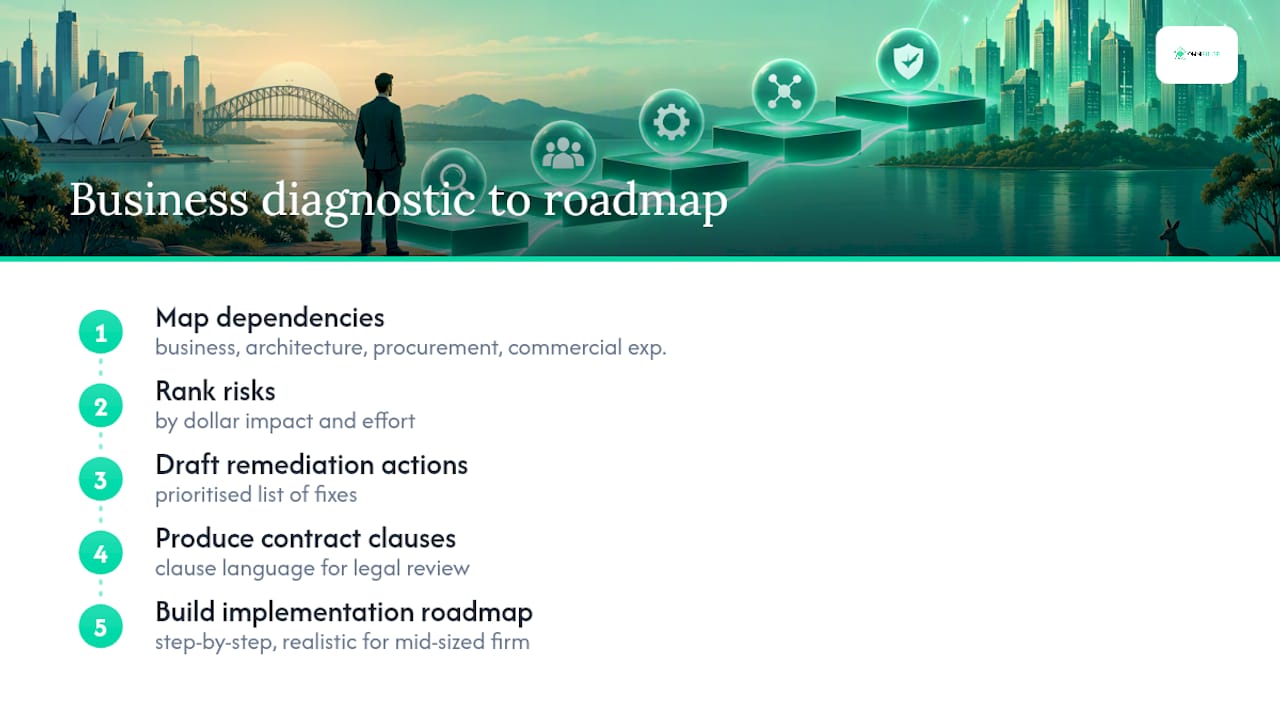
A thorough business diagnostic process maps exactly where AI dependency sits across a business, architecture, procurement terms, and commercial exposure, before ranking what to fix first by dollar impact and effort. The output isn’t a generic risk report. It’s a prioritised list of remediation actions, contract clause language ready for legal review, and a step-by-step implementation roadmap built around what a mid-sized business can realistically execute. That specificity is the difference between knowing you have a lock-in problem and knowing which three moves actually fix it.
What do real AI vendor lock-in scenarios look like?
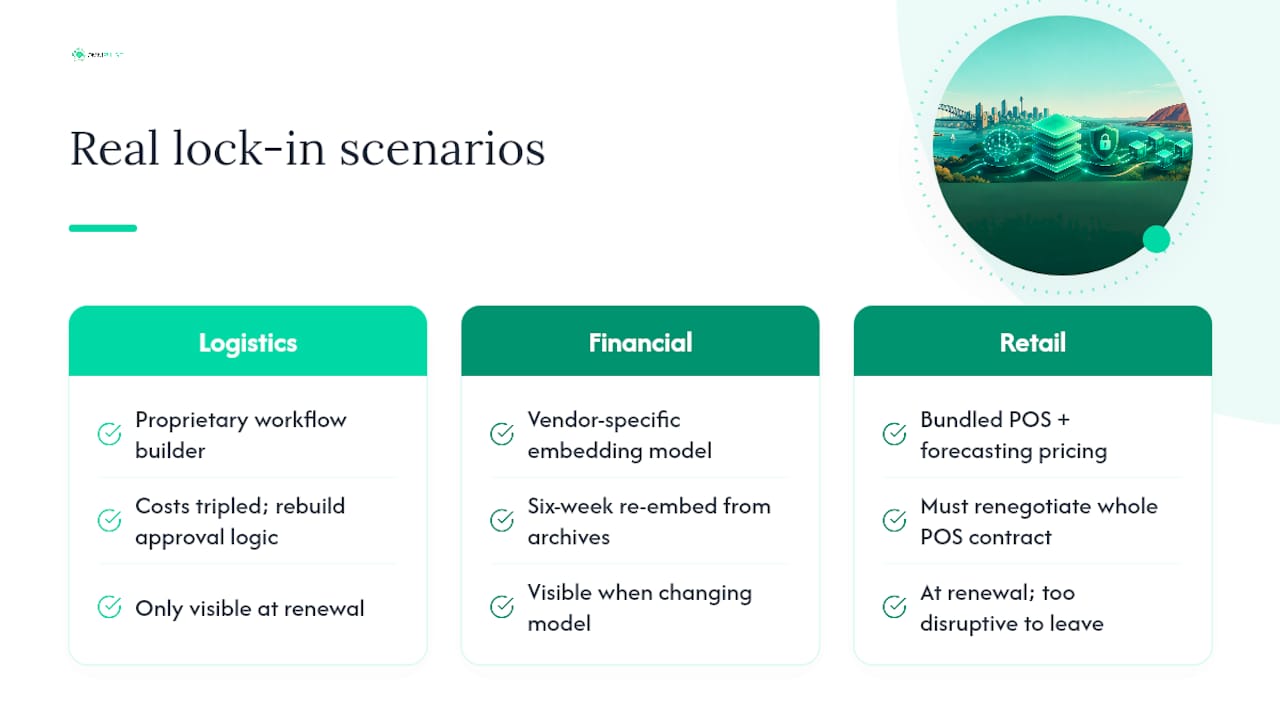
The clearest examples share a pattern: the trap wasn’t obvious at signing, and it only became visible at renewal.
A mid-sized logistics business built a customer service agent deeply integrated with one vendor’s orchestration tools, complete with custom approval workflows for refund decisions. Eighteen months in, the vendor restructured pricing around per-token consumption instead of a flat monthly fee. Costs tripled in one quarter. Migrating meant rebuilding the approval logic from scratch, because none of it existed outside the vendor’s proprietary workflow builder.
A financial services firm ran embeddings for its document search tool through a vendor-specific embedding model. When it wanted to switch to a newer, cheaper model from a different provider, every embedding had to be regenerated from the original source documents, a process that took its data team six weeks and required pulling records out of three separate archival systems.
A retail chain adopted an AI-driven inventory forecasting tool bundled with the vendor’s existing point-of-sale platform. The forecasting tool performed well, but unwinding it at renewal meant renegotiating the entire point-of-sale contract too, because the vendor had bundled pricing across both services. The forecasting tool alone wasn’t worth the disruption of touching the whole relationship, so the business stayed, at a higher price than the market rate for forecasting alone.
Each case has the same root cause: the switching cost wasn’t in the data. It was in workflows and pricing structures nobody stress-tested before signing.
What legal and regulatory issues does AI vendor lock-in raise?
Regulatory exposure compounds the commercial risk, particularly around auditability and data residency. If a regulator asks how an automated decision was reached, and the explanation lives entirely inside a vendor’s proprietary logging system you can’t export in a readable format, you have a compliance gap, not just a technical inconvenience.
Data residency rules add another layer. Organisations handling sensitive personal or financial information need to know exactly where their data physically sits and who can access it, and a vendor’s infrastructure choices may not align with those obligations as regulations shift. The Victorian Government’s procurement guidance recommends buyers require suppliers to disclose their AI use explicitly and include contract clauses supporting ongoing monitoring, precisely because relying on a vendor’s self-reported compliance after the fact leaves organisations exposed if that vendor’s practices change.
There’s also a liability question that’s easy to overlook. If a vendor’s AI system makes an error that affects a customer, and your contract doesn’t clearly assign responsibility for testing, monitoring, and remediation, you may find yourself with less contractual protection than you assumed. Contracts written before AI features were introduced often don’t address AI at all, which is exactly why a schedule of permitted AI uses matters: it forces an explicit conversation about what the vendor can and can’t automate on your behalf, rather than leaving it to be discovered after something goes wrong.
How do the costs of lock-in compound over time?
The financial damage from AI vendor lock-in rarely shows up as one bill. It builds in layers, each one making the next harder to absorb.
Year one usually looks fine. Pricing is competitive, onboarding support is generous, and the vendor has every incentive to make switching in feel easy. The cost curve bends upward once your workflows are deeply embedded and the vendor knows it: usage-based pricing increases, feature bundling pushes you toward paying for services you didn’t originally want, and support response times slow because you’re no longer a prospective customer they need to impress.
The compounding cost isn’t just the invoice. It’s the opportunity cost of staying with a vendor whose roadmap no longer matches your needs, because switching now requires rebuilding months or years of workflow logic. Every quarter you delay reviewing your exposure is a quarter that logic gets more entangled and more expensive to unwind.
Organisations that build in portability from the start, exportable prompts, an internal routing layer, contract clauses guaranteeing artefact access, pay a small upfront cost in engineering time and legal review. Organisations that skip it pay a much larger cost later, usually at the worst possible moment: during a renewal negotiation where the vendor already knows you have no real alternative.
Editorial take: the procurement gap nobody’s fixing
Most advice on AI vendor lock-in treats it as a technical problem to be solved with better architecture diagrams. That’s half right. The architecture matters, a routing layer genuinely does turn model choice into a configuration decision instead of a rewrite, but the bigger gap sits in procurement, where most mid-sized businesses simply don’t ask the exportability question until it’s too late to matter.
What’s overrated is the vendor’s own portability marketing. Every AI provider now claims to support “open standards” and “easy migration” somewhere in their sales deck. What’s underrated is the acceptance test: actually attempting an export before you sign, not after, so you know exactly what “portable” means in practice rather than in theory.
If there’s one place to start, it’s not the technology stack. It’s the contract you’re about to sign or the one you’re about to renew. Get the artefact export clause and the schedule of permitted AI uses right first. The architecture work matters, but it’s easier to fix later than a contract that never gave you the right to leave.
— Brodie S
Sources
FAQ
What does “vendor lock-in” mean?
Vendor lock-in means a business becomes so dependent on one provider’s technology, pricing structure, or workflows that switching to a competitor becomes prohibitively costly or complex. With AI specifically, the dependency often sits in tuned prompts, embeddings, and agent workflows rather than raw data, which is what makes it harder to unwind than traditional software lock-in.
What are the downsides of vendor lock-in?
The main downsides are reduced negotiating leverage at renewal, exposure to unpredictable pricing changes like per-token cost shifts, operational risk if the vendor has an outage or discontinues a service, and compliance gaps if your audit trail lives entirely in a proprietary format you can’t export.
How do you deal with vendor lock-in?
Build a model-agnostic routing layer so your applications talk to your own interface rather than a vendor’s API directly, and negotiate contract clauses guaranteeing export of prompts, embeddings, and workflow configurations at any time. Combining architectural abstraction with procurement controls, as Australia’s Whole-of-Government Cloud Computing Policy recommends, is the most reliable combination.
Can you give me an example of AI vendor lock-in?
A common scenario is a business building a customer service agent with deeply customised approval workflows inside one vendor’s orchestration tools, then facing a sudden pricing restructure at renewal. Migrating means rebuilding those workflows from scratch, because the logic was never exportable outside that vendor’s proprietary builder.