Turn Your AI Readiness Assessment Into a Six-Figure Efficiency and Revenue Roadmap
11 min readOmniPulse
An AI readiness assessment gives you a readiness score, a heat map across pillars like data and governance, and a ranked list of actions, usually within a session or two. It exists to answer one question: where should you spend on AI to get a return, and where would you just be burning money on infrastructure you can’t use yet. Any executive weighing an AI investment should run one before committing budget, not after.
TL;DR:
A comprehensive AI readiness assessment evaluates strategy, governance, data, infrastructure, talent, and model management, revealing specific weaknesses that can hinder AI success.
Different assessment formats range from quick surveys to deep diagnostics, with the choice depending on how much capital is at stake and decision complexity.
Prioritizing AI opportunities should be based on value and feasibility, focusing on high-value, high-feasibility pilots first, and delaying low-value, low-feasibility projects.
Effective implementation requires clear ownership, a risk assessment, ongoing monitoring, and measurable KPIs, with assessments ideally run at the workflow level, not enterprise-wide.
Turning a score into revenue involves surfacing dollar-weighted opportunities through workflow diagnostics that identify measurable, high-impact improvements.
Table of Contents
-
What does an AI readiness assessment measure across your business?
-
From assessment to guaranteed revenue: the OmniPulse diagnostic
-
What does a readiness assessment look like once it’s actually run?
-
When should you run this in-house versus bring in outside help?
What does an AI readiness assessment measure across your business?
Every credible framework, from MITRE’s AI Maturity Model to Gartner’s maturity toolkit, scores the same handful of pillars: strategy, governance and security, data foundations, infrastructure, talent and culture, and model management. Each one exposes a different failure mode, and low scores in any single pillar tend to sabotage the others.
-
Strategy measures whether AI investment ties to a specific business outcome. Weak scores here usually mean leadership wants “AI” without agreeing on what problem it should solve, and projects stall in committee.
-
Governance and security checks whether anyone owns risk, testing and monitoring. This is where Australian essential practices become directly relevant. No named owner here means no one is accountable when a model gets something wrong in front of a customer.
-
Data foundations looks at whether your data is accurate, accessible and structured enough to feed a model. Fragmented spreadsheets and inconsistent CRM records are the most common weakness, and they quietly cap every AI initiative you attempt.
-
Infrastructure assesses compute, integration and tooling. Businesses running on ten-year-old legacy systems often discover this pillar is their real bottleneck, not talent or budget.
-
Talent and culture measures whether staff can use and trust AI outputs. Low scores here show up later as shadow IT, where teams quietly bypass the “official” tool because it doesn’t fit how they work.
-
Model management covers how you monitor, retrain and retire models over time. Skipping this pillar is why pilots that work in month one degrade silently by month six.
Pillars are rarely weighted equally. A mid-sized business with strong data but no named AI owner will score differently to one with clear governance but chaotic data, even if their overall numbers land close together. Read the pillar breakdown before you trust the single number at the top.
How is an AI readiness assessment structured?
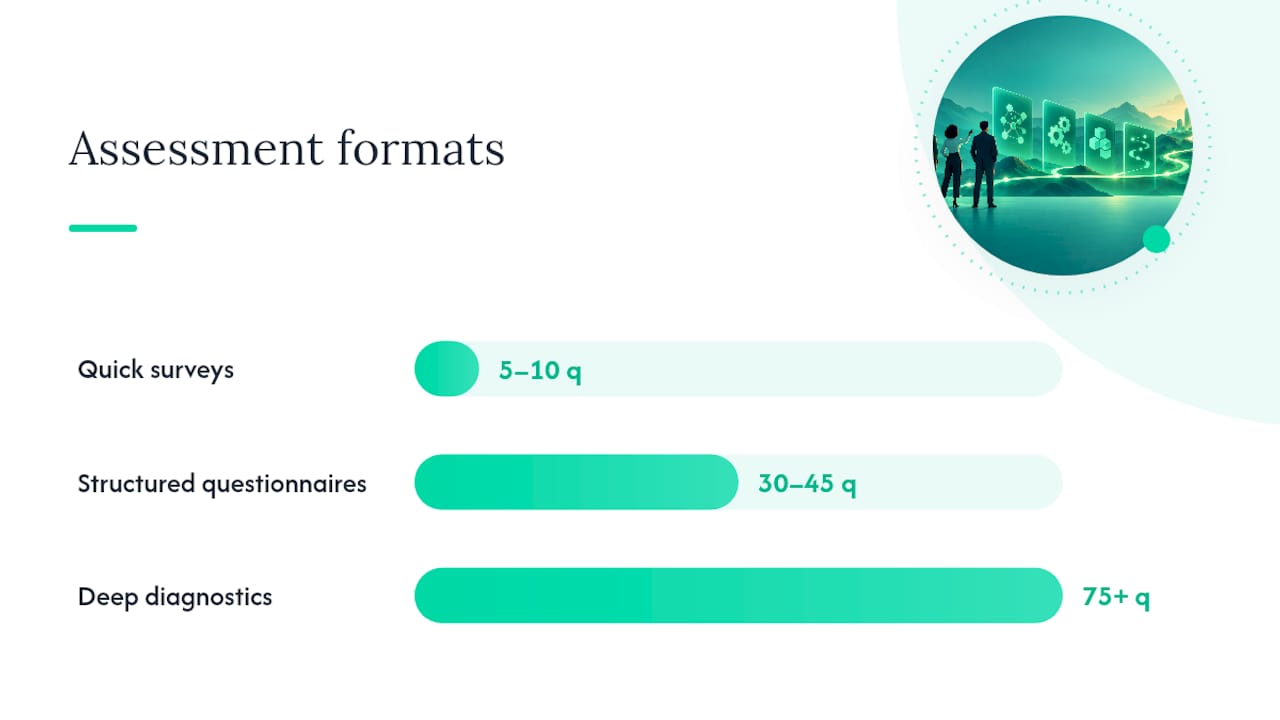
Formats range from a five-minute pulse check to a genuine diagnostic that takes days to complete properly, and the right choice depends on what decision you’re trying to make.
-
Quick surveys run 5 to 10 questions and give a directional read: are you broadly ready, broadly not, or somewhere in the messy middle. Useful for a first conversation with the board, not for allocating budget.
-
Structured questionnaires run 30 to 45 questions across the six pillars above, closer to what MITRE’s assessment tool or Gartner’s model would produce, and they’re detailed enough to support a real prioritisation exercise.
-
Deep diagnostics can extend to 75 or more questions, similar in scope to TDWI’s interactive AI readiness assessment, and are typically used when a business is about to commit significant capital and wants a defensible business case.
Who answers matters as much as which format you pick. Get leadership, the data or IT team, and frontline operations to complete the same assessment separately. When their scores diverge sharply on governance or data readiness, that gap is the finding, not noise to average away.
Representative questions look like this: “Can you name the person accountable for AI risk decisions?” (governance), “Can your team pull a clean customer dataset without manual cleanup?” (data), “Would staff trust an AI-generated recommendation enough to act on it unsupervised?” (talent and culture).
Pro Tip: Run the assessment against one specific workflow, like quote generation or inventory forecasting, rather than “the whole business.” A workflow-level assessment produces concrete, arguable priorities. An enterprise-wide one produces a vague number nobody acts on.
How do you turn a readiness score into a priority list?
Scores get visualised as a heat map, red through green across each pillar, often paired with a readiness level (something like “exploring,” “developing,” “scaling”). The number matters less than the pattern underneath it, and Gartner is explicit that a maturity model is a diagnostic tool for finding gaps, not a report card to file away.
The prioritisation rule that actually works is simple: rank opportunities by value multiplied by feasibility, not by which pillar scored lowest. A governance fix might be cheap and urgent even at low dollar value. A high-value AI use case sitting on broken data foundations should wait, no matter how appealing the projected return looks on a slide.
-
High value, high feasibility: pilot immediately.
-
High value, low feasibility: fix the underlying blocker first (usually data or infrastructure), then pilot.
-
Low value, high feasibility: park it. Don’t let easy wins crowd out real ones.
-
Low value, low feasibility: drop it from the roadmap entirely.
Build the roadmap as a single page: three to five actions, an owner for each, and a review date. Cisco’s 2025 Readiness Index found 81% of organisations report a clear owner for AI, yet only 32% have integrated workforce planning and only 32% have a process to measure AI’s actual impact. That gap between naming an owner and actually tracking outcomes is where most readiness efforts quietly stall. Re-assess every two quarters, and track fewer than five metrics per pilot so the review stays honest rather than becoming its own project.
How do you pick and run your first AI pilot safely?
Choose the pilot workflow on three criteria: expected return, how clean the underlying data already is, and how complex it is to execute without disrupting daily operations. A workflow that’s high-value but touches messy customer data will cost you more in cleanup than the pilot is worth in year one.
-
Confirm data access. Can the team actually pull what the pilot needs without a month of manual wrangling?
-
Set two or three measurable KPIs before you start. If you can’t define success now, you won’t recognise it later.
-
Write acceptance criteria: what result means you scale this, and what result means you kill it.
-
Run a compliance check against your obligations, including the governance and record-keeping guardrails set out in Australia’s Voluntary AI Safety Standard.
-
Assign a monitoring plan and a named owner before deployment, not after something goes wrong.
Minimum governance before anything goes live: one accountable owner, a documented risk assessment, an ongoing monitoring plan, and clear disclosure to anyone affected by the output. Skipping any of these four is how a promising pilot turns into a preventable mess.
Pro Tip: Measure success against the KPI you set beforehand, not against how impressive the demo looked. Demos are built to impress. KPIs are built to tell you the truth.
From assessment to guaranteed revenue: the OmniPulse diagnostic
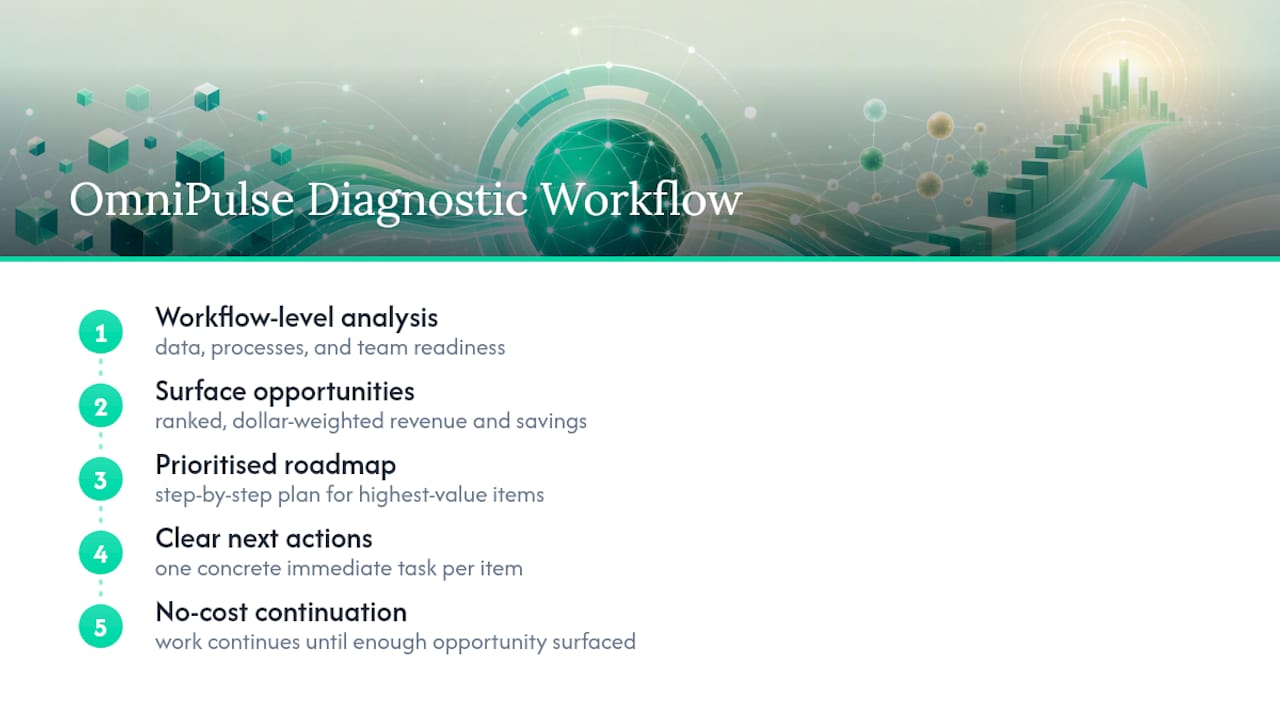
A generic pillar score tells you where you’re weak. It doesn’t tell you which fix pays for itself in ninety days. That’s the gap Omnipulse’s Business Diagnostic Process is built to close: a workflow-level analysis of your data, processes and team readiness that surfaces specific, dollar-weighted opportunities rather than a generic maturity label.
Looking at workflows, instead of big, vague company-wide strategies is the best way to find practical AI opportunities. The strategy delivers three things: a ranked list of opportunities, a step-by-step 30-60-90 day action plan, and a clear internal owner for each. The engagement runs as a fixed 4-week diagnostic process that delivers a complete strategy on your desk in 28 days flat. OmniPulse’s stated position is direct: the engagement comes with a personal guarantee that if it doesn’t surface six figures worth of hidden revenue opportunity, work continues for free until it does.
How do you get leadership and staff to actually buy in?
Present the readiness score as a business case, not an audit result. A pillar heat map means nothing to a sales director unless it’s tied to a number they recognise, like “our lead scoring workflow is currently costing us four hours a week in manual review.”
Translate each low-scoring pillar into a specific business risk or missed opportunity before you present it. “Governance scored red” lands as abstract compliance talk. “We have no named owner for AI risk, which means we can’t safely deploy the pricing tool marketing wants” gets a room’s attention.
Bring the scoring discrepancies into the room deliberately. If leadership rated data readiness a 7 and the operations team rated it a 3, that gap is worth discussing openly rather than averaging away, because it usually reveals exactly where resistance or misunderstanding will surface later. Treat the disagreement as useful information, not an inconvenience to smooth over in the final deck.
Close every stakeholder conversation with the one-page roadmap, not the full pillar breakdown. Executives buy into three ranked actions with owners and dates. They don’t buy into a twelve-tab spreadsheet, and burying the real decision inside one guarantees it never gets made.
What does a readiness assessment look like once it’s actually run?
A mid-sized logistics operator running a readiness assessment against its dispatch scheduling workflow typically finds the same pattern repeatedly: strong leadership appetite for AI, a genuinely capable data team, and a governance pillar that scores poorly because no one has formally been assigned to own model risk.
The useful output isn’t the discovery that governance is weak. It’s the sequencing that follows: fix the ownership gap first, because it’s cheap and fast, then pilot the scheduling optimisation once someone is accountable for what the model recommends. Businesses that pilot before assigning an owner tend to discover the governance problem only after the model has already made a customer-facing mistake, which is a far more expensive way to learn the same lesson.
The pattern holds across industries. A professional services firm might score well on data and poorly on talent readiness, meaning the fix is training and change management rather than a new tool purchase. The specific weak pillar changes. The principle, that the assessment’s value is entirely in what you do with the ranked gap, does not.
When should you run this in-house versus bring in outside help?
A quick internal pulse check works fine for early exploration or low-stakes pilots. Commission an external diagnostic when scores conflict across teams, no one can name a clear owner, or real revenue is riding on the decision. Budget a day or two for the internal version, a focused engagement for the external one.
Brodie. S
Ready to turn your readiness score into revenue?
A readiness assessment tells you where you stand. It won’t tell you what to fix this quarter and what is a distraction dressed up as a project. That’s the difference between a scorecard and a diagnostic, and it’s exactly where A Business Diagnostic Process picks up: a workflow-level analysis that ranks opportunities by value and feasibility, backed by a guarantee to keep working at no extra cost if it doesn’t surface six figures worth of hidden revenue opportunity to justify the engagement.

A 30-minute session gets specific fast. You’ll walk through your highest-friction workflow, the questions cover data access, current ownership and where the biggest time or cost drain actually sits, you’ll leave with a clear view of what a full diagnostic would prioritise first. There’s no generic checklist involved. If you’re ready to move past the scorecard stage, book your 30-minute AI readiness session or read more about the full strategy engagement on the Omnipulse site.
Where to go for deeper frameworks and data
For readers who want to go further than this article, three sources are worth your time directly:
-
Australia’s essential AI practices and Voluntary AI Safety Standard, covering the governance and risk baseline expected of Australian organisations deploying AI.
-
The Cisco AI Readiness Index, for benchmark data across six readiness pillars.
-
MITRE’s AI Maturity Model, a practical multi-dimension framework worth borrowing questions from directly.
Sources
FAQ
What is an AI readiness assessment?
It’s a structured evaluation of how prepared your business is to adopt AI, scored across pillars like strategy, data, governance, infrastructure, talent and model management. The output is typically a readiness score, a pillar-by-pillar breakdown, and a set of recommended next actions.
How do you measure AI readiness?
You measure it by scoring each pillar, usually through a questionnaire answered by leadership, data teams and operations separately, then comparing where those scores agree and where they diverge. Frameworks like Gartner’s AI maturity model and MITRE’s assessment tool structure this scoring around defined dimensions and maturity levels rather than a single opinion.
What is the 30% rule in AI?
There’s no single, widely recognised “30% rule” in AI readiness frameworks, and definitions circulating online vary. If you’ve heard the term used in a specific context, it’s worth checking that source directly rather than assuming a universal standard exists.
What is a readiness assessment?
Outside AI specifically, a readiness assessment is any structured check of whether an organisation, system or team has the capability, resources and processes needed before undertaking a change. In the AI context, that means checking data quality, governance, infrastructure and skills before committing budget to deployment.
Does Omnipulse offer an AI readiness assessment?
Omnipulse’s Business Diagnostic Process goes beyond a standard readiness score, analysing a specific workflow to surface ranked revenue opportunities and a prioritised roadmap. The strategy engagement is a one-off fee, listed on the Omnipulse site, with current pricing detail available there.