Make AI ISO aligned: AI operating model for Australian leaders
18 min readOmniPulse

An AI operating model is the organisational system that connects people, processes, data, technology and governance to reliably turn AI into repeatable business value. Success looks like this: any AI initiative can be traced to an accountable owner, tested against a documented process, and audited against a standard like AS ISO/IEC 42001, rather than living as a one-off pilot nobody can explain a year later. Groups like the Department of Industry and firms like OmniPulse both point to the same conclusion, structure beats enthusiasm.
TL;DR:
- Most organizations need a formal AI operating model that delineates ownership, processes, data infrastructure, and governance to ensure AI is reliable and repeatable.
- The typical AI operating model consists of four layers: roles and accountability, lifecycle processes, shared platform and data tools, and compliance policies aligned with standards like ISO/IEC 42001.
- Four common patterns include siloed teams, a central center of excellence, a hub-and-spoke system, and fully embedded AI capabilities, with most organizations maturing from centralized to distributed over time.
- Clear accountability roles such as AI officers, product owners, data engineers, and domain experts are essential, with explicit decision rights to prevent failure points.
- Building an AI operating model requires ongoing investment in data quality, technical infrastructure, continuous monitoring, and human oversight rather than a one-time project.
Table of Contents
- What does an AI operating model actually cover?
- Common AI operating model types and when to use each
- Structure, teams and accountabilities: who actually owns AI?
- Mapping ISO/IEC 42001 and national guidance into governance
- Implementation roadmap: from pilot to scale
- Metrics, monitoring and keeping the lifecycle alive
- OmniPulse’s diagnostic approach: from model to execution
- Fitting an AI operating model around legacy systems
- Change management and cultural transformation
- Technology and platform choices that actually scale
- Data management and quality as the foundation
- What an AI operating model actually costs to run
- What successful implementations tend to have in common
- Three pitfalls that quietly sink most AI programs
- Book a readiness session with OmniPulse
- Sources
- FAQ
What does an AI operating model actually cover?
Most organisations already have AI running somewhere, in a spreadsheet macro dressed up as machine learning, in a marketing tool nobody vetted, in a data scientist’s laptop. An operating model is what turns that scattered activity into something a board can trust and a regulator can inspect.
Four layers make up a working model:
- People and roles — who owns AI decisions, who builds, who monitors, and who can pull the plug.
- Processes and lifecycle — how an idea moves from proposal to pilot to production, and how it gets retired.
- Platform and data — the shared infrastructure, from data pipelines to deployment tooling, that stops every team reinventing the wheel.
- Governance and assurance — the policies, registers and review cadences that keep the whole thing auditable.
The difference between this and a typical AI project is scope. A project has a start and an end date. An operating model persists, absorbing new use cases, retraining models, and adapting as regulation shifts. The Guidance for AI Adoption from the Department of Industry, Science and Resources exists precisely because most businesses skip this step, they run pilots, get a result, and never build the scaffolding to repeat it safely. AS ISO/IEC 42001:2023 gives that scaffolding a formal shape, treating AI management the way ISO 27001 treats information security: as a system, not a series of one-off decisions.
Common AI operating model types and when to use each
There is no single correct AI target operating model. The right pattern depends on how many use cases you are running, how much risk each one carries, and how mature your data function already is. Four patterns show up repeatedly across organisations of every size.
- Siloed model. Individual teams or departments build and run their own AI tools with little central coordination. This tends to happen early, often by accident, when a sales team adopts a forecasting tool and finance builds its own anomaly detector independently. It moves fast but multiplies risk: no shared standards, duplicated spend, and no single view of what AI is actually doing across the business.
- Centre of excellence (CoE). A dedicated central team sets standards, builds shared tools, and often executes AI work on behalf of the business. This concentrates expertise and enforces consistency, but it can become a bottleneck once demand for AI outstrips the team’s capacity to deliver it.
- Hub and spoke, or centre for acceleration. The centre sets standards, platforms and governance; business units run their own use cases within those guardrails. This is the most common evolution point for mid-sized organisations because it balances speed with control.
- Embedded or fully distributed model. AI capability sits inside every business unit, with the centre reduced to a light-touch governance function. This only works once an organisation has mature data foundations, a strong risk culture, and enough institutional experience that individual teams can be trusted to self-govern.
Most organisations should not try to start distributed. Begin with a small central function that owns the first few use cases directly, then hand ownership to business units as capability and confidence grow. Trying to skip straight to a fully embedded model without that groundwork is the fastest way to end up back at siloed chaos, just with better branding.
Structure, teams and accountabilities: who actually owns AI?
Once you have picked a pattern, someone has to be accountable for it. Ambiguity here is the single most common failure point in AI programs, not lack of budget or tooling.
A handful of roles need to exist somewhere in the structure, even if one person covers two:
- AI accountable officer — the named individual who owns outcomes, risk and reporting, typically sitting at executive level.
- CoE or platform lead — owns shared tooling, standards and technical governance.
- Product owner — owns a specific use case’s business value and success metrics.
- MLOps engineer — owns deployment, monitoring and retraining pipelines.
- Data engineer — owns pipeline reliability and data quality for the use cases in scope.
- Domain owner — the business unit representative who understands the workflow the AI is touching and signs off on fit for purpose.
Decision rights need to be explicit rather than assumed. A simple approach borrowed from RACI logic works well here: for every AI initiative, name who is accountable for the outcome, who is responsible for building it, who must be consulted before it ships, and who just needs to be informed. Write it down. Verbal agreements about “who owns this” evaporate the moment something goes wrong.
Incentive design matters more than most leaders expect. If teams are rewarded for shipping AI features but nobody is rewarded for maintaining them, you get a graveyard of unmonitored models within eighteen months. Avoid the headcount-to-output trap too, hiring five data scientists does not automatically produce five times the value if the surrounding process can’t absorb their output.
Pro Tip: Before hiring a single new AI role, map which of the six accountabilities above are currently unowned. Most organisations discover they need reallocation, not headcount.
Mapping ISO/IEC 42001 and national guidance into governance
Governance sounds abstract until you ask a simple question: if an AI system made a bad decision tomorrow, could you show a regulator exactly how it was approved, tested and monitored? Most organisations cannot. That gap is what an AI governance operating model closes.
A handful of documented artefacts do most of the work:
- AI policy — the organisation’s stated position on acceptable use, approval thresholds and escalation paths.
- AI register — a living inventory of every AI system in use, its purpose, owner and risk rating.
- Impact and risk assessments — conducted before deployment and revisited on a schedule.
- Monitoring and incident processes — defined triggers for retraining, rollback or escalation.
AS ISO/IEC 42001:2023 gives these artefacts a formal structure, treating an AI management system the same way established quality and security standards treat their domains: as something you can certify against, not just aspire to. The Guidance for AI Adoption’s six essential practices map almost directly onto these artefacts, accountability, risk assessment, testing, monitoring, human oversight and stakeholder engagement each correspond to a specific governance routine rather than a vague principle.
Privacy obligations deserve their own line item. Under the Privacy Act, organisations must conduct due diligence on commercially available AI products and disclose clearly when personal information feeds into or comes out of an AI system. Build this into procurement from day one, not as an afterthought once legal flags a vendor contract.
As of 2024–25, 22% of medium-sized businesses have adopted AI, a higher rate compared to the share across all Australian businesses. That gap is exactly why formal governance matters more for this size bracket, not less: mid-sized organisations are moving fast enough to create real risk exposure, often without the compliance infrastructure a larger enterprise would already have in place.
Implementation roadmap: from pilot to scale
Getting from “we should use AI” to a working operating model follows a reasonably predictable sequence, even though the specific use cases differ wildly by industry.
- Prioritise by value, feasibility and risk. Score every candidate use case against expected business value, how hard it is to build given current data maturity, and how much regulatory or reputational risk it carries. A high-value, low-feasibility idea is a two-year project, not a pilot.
- Build a balanced starter portfolio. Pick two or three initiatives spanning quick wins and one genuinely ambitious bet. A portfolio of only easy wins never builds organisational muscle; a portfolio of only hard problems burns credibility before it delivers anything.
- Invest in minimum viable platform. You need an AI register, a basic MLOps pipeline, monitoring dashboards and a repeatable deployment pattern before your third use case, not your thirtieth. Retrofitting this after the fact costs multiples more than building it early.
- Pull the adoption levers deliberately. Executive sponsorship that shows up in meetings, not just in a memo. Training that builds genuine literacy, not a one-hour webinar. Pilots scoped small enough to deliver a visible win within one quarter.
The organisations that stall almost always skipped step three. They ran a brilliant pilot, then had nowhere to put it, no monitoring, no register, no repeatable deployment path, so it stayed a demo forever.
Pro Tip: Treat your AI register as a living document from the first pilot, not something you build retrospectively once you have ten systems to catalogue. Retrofitting a register across a dozen live systems is a project in itself.
Metrics, monitoring and keeping the lifecycle alive
An AI system that worked well at launch can degrade quietly for months before anyone notices, until a customer complaint or an audit forces the question. Monitoring is not a nice-to-have bolted onto the platform layer; it is the mechanism that keeps the entire operating model honest.
Two categories of metrics need tracking side by side:
- Outcome KPIs — the business result the AI was built to move: revenue, cost, cycle time, error rate.
- Model-level metrics — accuracy against a held-out test set, drift in input data distribution, and periodic bias checks against defined fairness criteria.
| Monitoring element | Purpose | Typical review cadence |
|---|---|---|
| AI register entry | Tracks system purpose, owner, risk rating | Updated at every material change |
| Performance dashboard | Flags accuracy or drift issues | Weekly to monthly, depending on risk |
| Retraining trigger | Defines when a model needs refreshing | Set per model, reviewed quarterly |
| Human oversight checkpoint | Confirms a person can intervene before harm | Reviewed at deployment and after incidents |
National guidance recommends ongoing testing, monitoring and human oversight as core operational practices, not optional extras layered on for high-risk systems only. Set service level objectives that map directly to business targets, if a model’s accuracy drops below a defined threshold, that should trigger an automatic review, not wait for someone to notice the numbers look off in a quarterly report. Escalation and rollback paths need to exist before launch, not get improvised during an incident.
OmniPulse’s diagnostic approach: from model to execution
Most mid-sized businesses do not lack ambition around AI. They lack a clear map of where the real value sits and whether their data, workflows and teams can actually support it. That is the gap OmniPulse’s Business Diagnostic Process is built to close.
The diagnostic examines three things in sequence: what your data actually looks like versus what you assume it looks like, how your current workflows would need to change to absorb AI without breaking, and whether your teams have the readiness to run what gets built. From there, opportunities get prioritised by value and execution feasibility, not by whichever idea got the loudest pitch in a leadership meeting.

OmniPulse backs this with a guarantee: if the diagnostic does not surface sufficient six-figure opportunities, the engagement continues at no additional cost until it does. That structure matters for governance too. A prioritised, evidence-based roadmap makes it far easier to staff the accountable officer role, populate an AI register with real use cases, and set monitoring thresholds that reflect actual business risk rather than generic templates.
Fitting an AI operating model around legacy systems
Almost no organisation builds an AI operating model on a blank slate. There is a core banking platform from 2009, a CRM nobody wants to migrate away from, and three spreadsheets that quietly run half of operations. The operating model has to work with that reality, not pretend it away.
The practical starting point is an integration audit: which systems hold the data your priority AI use cases actually need, and what format does it leave in. Legacy systems frequently store data in ways that made sense fifteen years ago but require significant cleaning before any model can use them reliably. This is usually where timelines blow out, not in the modelling work itself.
API layers and middleware often solve more of this problem than a full system replacement would. Rather than ripping out a legacy platform, many organisations build a data extraction layer that feeds a modern pipeline while the legacy system keeps doing what it already does well. This reduces both cost and disruption, and it means the AI operating model can mature independently of a multi-year systems replacement program.
Process integration matters just as much as technical integration. An AI recommendation that lands in someone’s inbox as a PDF nobody opens has failed, regardless of how accurate the underlying model is. The output needs to sit inside the existing workflow, the same CRM screen, the same approval queue, the same dashboard staff already check every morning. Map the human workflow first, then decide where the AI output actually needs to appear within it.
Change management and cultural transformation
Technical design solves maybe half the problem. The other half is convincing people that a new system is worth trusting with decisions they used to make themselves, and that takes deliberate work.
Resistance to AI adoption rarely comes from people being anti-technology. It comes from a reasonable fear: that the system will make them look bad, replace their judgement without warning, or fail in a way they get blamed for. Addressing that fear directly, rather than dismissing it as change resistance, tends to work far better than a generic communications campaign.
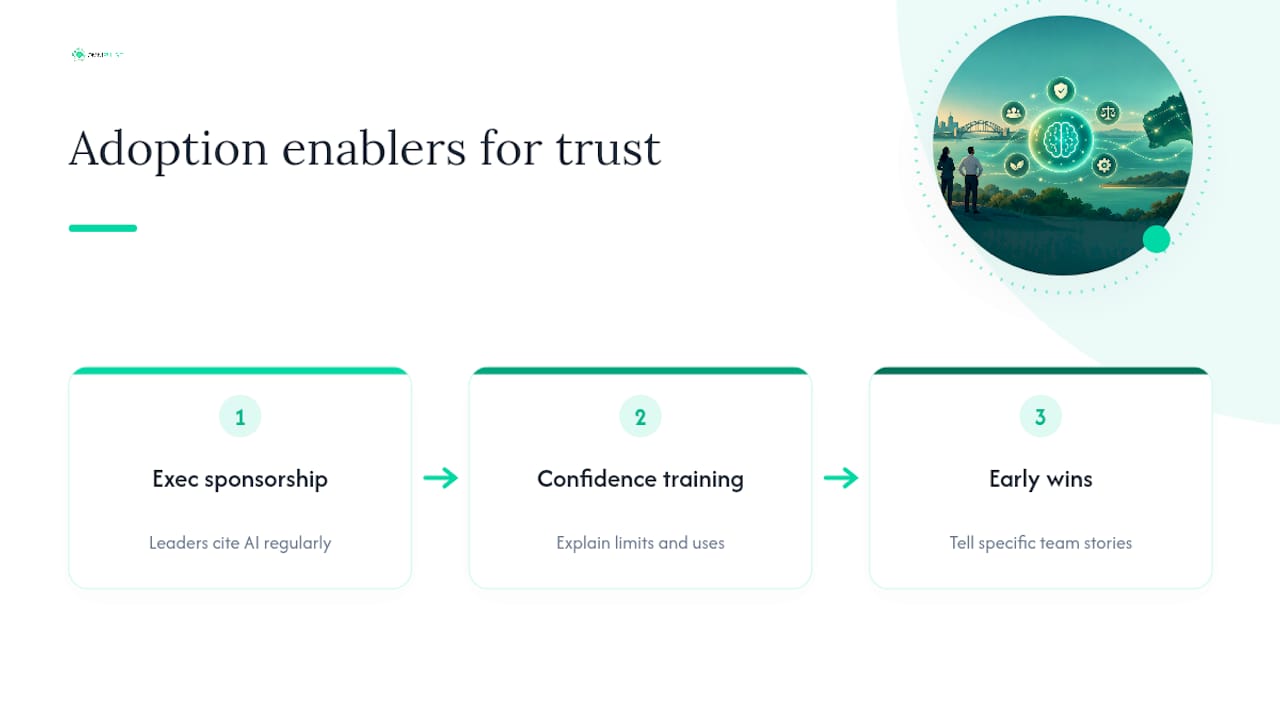
Three things move the needle consistently. First, visible executive sponsorship that goes beyond a launch email, leaders who reference the AI initiative in regular meetings signal it matters. Second, training that builds genuine confidence rather than a checkbox compliance session, staff need to understand what the tool can and cannot do, not just how to click through it. Third, early wins that get shared loudly. A single team saving genuine hours each week, told as a specific story rather than an aggregate statistic, does more for adoption than any slide deck.
Culture shifts fastest when people see AI handling the tedious parts of their job and freeing them for the parts that need actual judgement. It shifts slowest, or reverses entirely, when the first visible use case is one that threatens someone’s role without a clear transition plan. Sequence your pilots with that in mind.
Technology and platform choices that actually scale
The platform layer of an AI operating model is where a lot of budget gets wasted on tools that look impressive in a demo and collapse under real usage. A few structural choices matter more than which specific vendor you pick.
Separate your experimentation environment from your production environment early. Teams need room to test ideas without every prototype requiring the same compliance sign-off as a live customer-facing system, but that experimentation space needs clear boundaries so nothing leaks into production without proper review.
Standardise your deployment pipeline before your second use case, not your tenth. A repeatable pattern for how a model moves from validated to live saves enormous time later and makes monitoring consistent across every system in the register. This does not require an enterprise platform on day one, but it does require deciding on one approach and sticking with it rather than letting every team build its own deployment method.
Interoperability deserves genuine attention when you are choosing tools. A platform that cannot pull data from your existing systems, or push outputs back into the workflows staff already use, creates the PDF-nobody-opens problem described earlier. For organisations working in regulated or clinical domains, purpose-built platforms like Panora’s AI wellness layer for functional medicine and longevity clinics show how domain-specific tooling can embed directly into existing clinical workflows rather than sitting alongside them as a separate system staff have to remember to check.
Data management and quality as the foundation
Every AI model is only as good as the data feeding it, and this is the layer where most timelines and budgets get blown without anyone quite noticing until it is too late. A quality framework is not optional infrastructure, it is the difference between a model that works in testing and one that embarrasses the business in production.
Three practices matter more than the rest. Data lineage, knowing exactly where a piece of data came from and what transformations it has been through, lets you trace a bad output back to its source instead of guessing. Data quality checks at the point of ingestion, not just before model training, catch problems early when they are cheap to fix rather than late when they require retraining an entire system. And clear ownership of each dataset, someone whose job it is to know if the data has changed shape or gone stale, prevents the slow quality decay that causes model drift.

Governance and data quality are the same conversation, not two separate ones. The AI register mentioned earlier should record not just what a model does but what data it depends on and who is responsible for that data’s integrity. When a model’s performance drops, the first question should always be whether the underlying data changed before assuming the model itself broke. In practice, that is the more common cause by a wide margin.
What an AI operating model actually costs to run
Budgeting for an AI operating model trips up a lot of leaders because the biggest costs are not the ones that show up on a software invoice. Licensing for AI tools is often the smallest line item; the real spend sits in data preparation, integration work, ongoing monitoring, and the people needed to keep all of it running.
Upfront investment covers platform basics, an AI register, a deployment pipeline, monitoring dashboards, plus the diagnostic or discovery work needed to identify which use cases are actually worth pursuing. Ongoing costs cover model monitoring and retraining, governance overhead like risk assessments and audits, and the accountable roles who keep the system running rather than just building it once and walking away.
The mistake most organisations make is budgeting for the build and forgetting the maintain. A model that performs well at launch needs monitoring, occasional retraining, and periodic review against the AI register indefinitely, not for a single project cycle. Treat the operating model budget the way you would treat any other piece of core infrastructure: as an ongoing operational cost with a capital component at the start, not a one-off project spend that ends when the pilot ships.
What successful implementations tend to have in common
Specific case studies vary enormously by industry, but the pattern behind the successful ones is consistent: they treat the operating model as the product, not the individual AI use case as the product.
A retail business that gets forecasting right usually didn’t start with forecasting. It started by fixing the accountability gap, naming someone who owned AI outcomes, then built one contained use case to prove the model before expanding. A professional services firm that scales AI across multiple practice areas typically ran its centre of excellence phase for a year or more before devolving ownership to individual teams, resisting the temptation to distribute too early.
The common thread across sectors with higher AI adoption, professional, scientific and technical services and financial services among them according to the ABS’s 2024–25 data, is not access to better technology. It is that these sectors already run on structured processes and defined accountabilities, so an AI operating model slots into scaffolding that already exists. Businesses without that scaffolding need to build it as part of the AI rollout, not after.
Three pitfalls that quietly sink most AI programs
Working through this material repeatedly, three failure patterns show up far more often than any technology limitation ever does.
The first is no accountable owner. Ask any struggling AI program who is personally accountable for its outcomes, and you often get a shrug or a committee. Appoint a named AI accountable officer before you approve a second use case, not after the first one goes sideways.
The second is treating AI as a single IT project rather than an operating capability. Projects end. Capabilities need lifecycle management, monitoring, retraining triggers, a register, forever. If your AI initiative has a project close date, it is not an operating model yet.
The third, and most underestimated, is skipping meaningful human oversight in the pursuit of automation. A checkpoint that exists on paper but nobody actually reviews is not oversight, it is theatre. Build genuine intervention points where a human can and does override the system, and staff them with people who have the authority to act on what they see.
— Brodie S
Book a readiness session with OmniPulse
An alternative to a generic AI consultant for mid-sized businesses building an operating model is a Business Diagnostic Process that examines your actual data, workflows and team readiness before recommending anything.
Such an engagement can be built around finding hidden revenue opportunities prioritised by value and how realistically an organisation can execute them, potentially backed by a guarantee to continue working at no extra cost if sufficient opportunities are not initially surfaced. That is a meaningfully different starting point from a generic framework, because the roadmap you get reflects your systems and your people, not a template built for a different business entirely. The strategy engagement runs at $15,000 one off. If you want a lower-commitment first step, book a 30-minute AI readiness session and find out where your organisation’s biggest gaps actually sit before committing to anything further.
Sources
- Guidance for AI Adoption — Australian Government (Department of Industry, Science and Resources)
- Standards Australia adopts AS ISO/IEC 42001:2023
- OAIC guidance on privacy and the use of commercially available AI products
- Business adoption of artificial intelligence accelerates, 2024–25 — ABS media release
FAQ
What is an AI operating model?
An AI operating model is the combination of people, processes, platforms, data and governance that lets an organisation deploy and manage AI systems reliably rather than as one-off projects. It defines who is accountable, how initiatives move from idea to production, and how performance and risk get monitored over time. OmniPulse builds this through its diagnostic-led strategy engagement rather than a generic template.
What are the four types of AI operating models?
The four common patterns are siloed, where teams build AI independently; centre of excellence, where a central team sets standards and often delivers the work; hub and spoke, where a central function sets guardrails while business units execute; and embedded, where AI capability sits fully within each business unit under light central governance. Most organisations start centralised and evolve toward a more distributed pattern as capability matures.
What are the four main layers of an AI operating model?
The four layers are people and roles, processes and lifecycle management, platform and data infrastructure, and governance and assurance. Each layer needs its own accountabilities and artefacts, from a named AI accountable officer to an AI register, to function as a coherent system rather than disconnected pieces.
How does ISO/IEC 42001 relate to an AI operating model?
AS ISO/IEC 42001:2023 provides a certifiable management system standard that structures how organisations govern AI, similar to how ISO 27001 structures information security. It gives leaders a formal framework for the governance layer of their operating model, covering risk assessment, monitoring and accountability.
How much does an OmniPulse strategy engagement cost?
The OmniPulse strategy engagement is priced at $15,000 one off and includes the Business Diagnostic Process, opportunity prioritisation and a tailored roadmap. Leaders wanting a smaller first step can book a 30-minute readiness session instead.