Cut Adoption Risk: 4 Stage AI Change Management for Practitioners
8 min readOmniPulse

Treat AI adoption as workflow and people change first, technical integration second. Start with a narrow use case, define who does what before and after AI enters the process, and build training and pilot testing into the plan from day one. What follows is a staged playbook, drawn from national guidance and workplace research, that change practitioners can apply directly.
TL;DR:
- Trust, participation, and skills must develop alongside AI technology, emphasizing transparency, consultation, control, and visible benefits to ensure adoption.
- Starting with narrow, high-value use cases and implementing staged testing, monitoring, and optimization reduces risks and builds proven workflows before scaling.
- Governance should be integrated throughout the AI lifecycle, with clear accountability assigned to individuals rather than departments, especially during deployment and incident response.
- Redesigning workflows involves defining oversight patterns, decision rules, and documentation for roles, escalation, and quality standards to support responsible AI use.
- A thorough discovery process, like OmniPulse’s diagnostics, is crucial before expanding AI adoption, ensuring value is identified and actable, with pilots lasting several weeks and scheduled reviews.
Table of Contents
- Why a people-first approach matters for AI adoption
- A practical staged process: discover, implement, optimise, realise value
- Governance and accountability across the AI lifecycle
- Redesigning workflows: roles, oversight patterns and documentation
- Capability building: training, impact assessment and engagement
- Pilots, testing and measurement: running safe, informative experiments
- Practical checklist for AI change practitioners
- OmniPulse perspective: reducing risk before scaling
- How OmniPulse can help you plan the next step
- Sources
- FAQ
Why a people-first approach matters for AI adoption
Technical capability rarely fails first. Adoption fails when trust, participation and skill lag behind the technology, a pattern confirmed by empirical reviews of AI in organisations, which show that individual attitudes, team collaboration and organisational practice jointly determine whether a tool’s technical potential turns into real operational impact.
Messaging that leads with productivity gains alone tends to backfire. Workers hear “we will do more with less” as a threat to their role, not an offer of help. The National AI Centre’s guidance on bringing people along recommends a different sequence: explain what the tool can and cannot do, keep people involved in decisions that affect their work, and build practical skills before expecting adoption.
Trust builds on four things practitioners can actually control:
- Transparency: explain what the AI does, where its limits sit and why it was introduced.
- Consultation: involve the people whose workflows change before the change is finalised.
- Control: preserve a clear human decision point at the moments that matter.
- Visible benefit: show how the change reduces friction for the person doing the work, not just for the organisation.
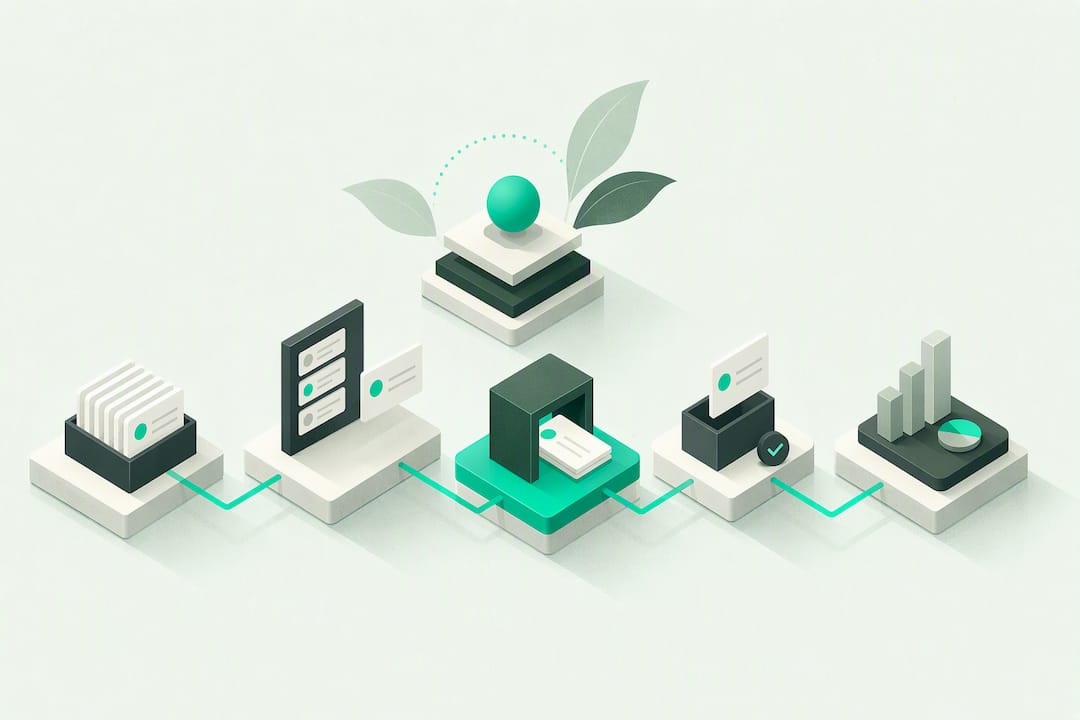
A practical staged process: discover, implement, optimise, realise value
A staged approach turns AI adoption from a single risky leap into a sequence of smaller, reversible decisions.
- Discover: pick one narrow, high-value use case rather than an enterprise-wide rollout. Map the end-to-end workflow the AI will touch and capture baseline metrics (time, error rate, volume) before anything changes.
- Implement and integrate: redesign the workflow with explicit AI and human responsibilities. Write acceptance criteria for AI outputs and escalation rules for when a human must intervene.
- Tune and optimise: deploy feedback loops that record which outputs people edit and why. Use that record to adjust prompts, models and checkpoints rather than guessing at fixes.
- Realise value: scale only the workflows that have proven themselves in pilot. Measure return against the baseline captured in discovery, and fold the process into ongoing governance so it does not quietly drift out of scope.
This sequence follows the structure the Actuaries Institute’s framework for AI governance sets out: start narrow, redesign the workflow with defined roles and decision rules, prototype and monitor, then scale what works. Each stage produces a concrete deliverable, a workflow map, a specification document, a monitoring log, a scaling business case, so the next stage never starts from a blank page.
Governance and accountability across the AI lifecycle
Governance is not a compliance afterthought bolted onto a finished project. It is an organisational design question that has to be answered before deployment, not after an incident.
An AI management system, as described in the National AI Centre’s implementation guidance, should cover the full lifecycle:
- Procurement and development: how tools are vetted before they touch a live workflow.
- Deployment: who signs off before a workflow goes live.
- Monitoring: who checks outputs, and how often.
- Incident response: what happens when an output causes harm or a near miss.
- Retirement: how a tool is decommissioned when it no longer fits.
Accountability needs to be assigned by name, not by department, and documented for internal teams, contractors and vendors alike, since responsibility blurs quickly wherever an AI system crosses an organisational boundary.
A 2025 survey of Australian organisations found that many struggle with integrating generative AI into legacy systems, training gaps and measuring ROI, a pattern that points squarely at governance and change management gaps rather than model performance.
Redesigning workflows: roles, oversight patterns and documentation
Once a use case is chosen, the real work is redesigning the workflow itself: deciding exactly where AI acts, where a person checks, and where a person decides.
Four oversight patterns cover most cases:
| Oversight pattern | When to use it | Decision rule |
|---|---|---|
| Human-in-the-loop | High-stakes or irreversible decisions | Human approves every output before it is actioned |
| Human-on-the-loop | Moderate stakes, high volume | AI acts automatically; human monitors and can intervene |
| Spot-check | Low stakes, stable performance | Human reviews a sample on a set schedule |
| Exception handling | Routine processing with edge cases | AI handles standard cases; anything outside defined rules escalates to a human |
Each redesigned process deserves a short specification covering the process diagram, role assignments, decision rules, quality standards, escalation paths, training required and the technical components involved, a structure the Actuaries Institute recommends as standard practice. A customer service team, for example, might let AI draft every reply, require human-on-the-loop review for standard queries, and escalate anything mentioning a refund above a set threshold to a supervisor with human-in-the-loop sign-off.
Capability building: training, impact assessment and engagement
Skills and confidence do not follow automatically from a tool being switched on. They need to be built deliberately, role by role.
- Role-based impact assessments identify exactly which tasks change for each role, what new skills are needed, and where support gaps will show up first.
- Hands-on pilots with oversight let people practise on real work at low stakes, building competence faster than a slide deck ever will.
- Early involvement turns likely sceptics into advocates; people who help shape a change are far less likely to resist it later.
Middle managers deserve particular attention here. An ANU working paper found that exposure to labour-displacement information reduced managers’ willingness to adopt and advocate for AI, which makes managers a gatekeeper group worth engaging directly rather than assuming their support.
Pro Tip: Run the first training session with the team that will feel the change most, before the wider rollout, so their questions shape the material everyone else receives.

Pilots, testing and measurement: running safe, informative experiments
A pilot’s job is to surface risk cheaply before a mistake gets expensive.
- Test with low-risk prototypes first: paper-based walkthroughs, exception testing and load checks reveal failure modes before a system touches live work.
- Measure what actually matters: accuracy, how often people edit AI outputs, time saved against the baseline, adoption rates and trust indicators such as willingness to rely on the output unchecked.
- Capture the feedback loop: record why an output was edited, not just that it was, and schedule recurring review points rather than a single go-live check.
The National AI Centre’s guidance on redesigning workflows is blunt on this point: a pilot without a feedback and revision loop is not a change management plan, it is a demo.
Practical checklist for AI change practitioners
Before any rollout expands past its pilot, confirm the basics are in place.
- Use case is narrow, high-value and has a documented baseline.
- Workflow specification exists with roles, decision rules and escalation paths.
- Oversight pattern is chosen deliberately, not defaulted.
- Training has reached every affected role, not just power users.
- Feedback loop is active and reviewed on a set schedule.
- Red flags to watch: rising override rates, silent workarounds, and managers quietly avoiding the tool.
For a mid-sized organisation, the next three actions are: pick one workflow, write its specification, and run a four to six week pilot with a defined review date.
| Deliverable | Owner | Purpose |
|---|---|---|
| Workflow specification | Process owner | Defines roles, rules and escalation |
| Pilot review log | Change lead | Tracks edits, overrides and feedback |
| Scaling business case | Sponsor | Confirms ROI before wider rollout |
OmniPulse perspective: reducing risk before scaling
The playbook above only works if the discovery stage is done properly, and that is where most organisations underinvest. A Business Diagnostic Process exists to close that gap: a structured review of data, workflows and team readiness that surfaces where AI can create real value before a single workflow is redesigned. The output is a prioritised, tailored roadmap, not a generic best-practice list. It is claimed that the diagnostic will surface meaningful opportunities and that the provider will keep working at no additional cost until it does.
— Brodie S
How OmniPulse can help you plan the next step
Running the discovery stage well is the hardest part of this playbook, and it is exactly what OmniPulse’s strategy engagement is built to do. The engagement pairs the Business Diagnostic Process with a tailored roadmap, so you get a prioritised, workflow-level plan rather than a generic strategy deck.
The strategy engagement is a one-off $15,000 service, covering the diagnostic and the roadmap that follows it. If you want a lower-commitment first step, book a 30-minute AI readiness session and talk through where your organisation actually stands before committing to a full engagement.
Sources
- Understanding Australia’s AI: a framework for AI governance (Actuaries Institute)
- Bring your people along (National AI Centre)
- A multilevel review of artificial intelligence in organizations (Bankins et al.)
FAQ
How is AI used in change management?
AI change management applies standard change practice, communication, training, workflow redesign and governance, specifically to AI adoption, because the human and organisational factors determine whether the technology delivers real impact. The Actuaries Institute’s framework frames this as coordinating people, workflows, governance and technology together rather than treating AI as a purely technical rollout.
What is the 30% rule in AI?
Definitions circulating informally vary, so it is best treated as an unofficial rule of thumb rather than an established standard.
Will change managers be replaced by AI?
AI is more likely to reshape parts of the change manager’s role than remove it, since the discipline depends heavily on judgement, trust-building and stakeholder work that current guidance treats as distinctly human. Middle managers in particular have been shown to act as gatekeepers to adoption, a role that research on managerial behaviour suggests AI cannot simply substitute for.
What are the 5 pillars of change management?
Definitions of “five pillars” vary by framework, and no single source in this article sets out a canonical list under that name. The workstreams covered here, stakeholder impact assessment, leadership alignment, worker consultation, capability building and governance with human oversight, map closely to what most established change frameworks emphasise.
How long should an AI pilot run before scaling?
There is no universal fixed duration, since it depends on the workflow’s volume and risk profile, but a pilot should run long enough to capture a meaningful feedback loop, typically several weeks, with a defined review date built in from the start rather than an open-ended trial.